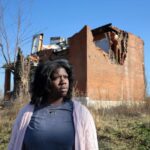
Daje Shelton became a mother at 17, with the father of that child now incarcerated for murder. Her journey from her involvement with gangs to finding the resolve to provide a better future for her son was recounted in an acclaimed documentary, For Ahkeem, that was filmed over two-and-a-half years and released to critical acclaim in 2017. Now 28, Shelton aspires to be a journalist and has taken communication classes at St. Louis Community College-Forest Park. Recently she ran into headwinds on her way to a brighter future. No, something worse than that. This story is her professional debut. The River City Journalism Fund is supporting her work.
By Daje Shelton
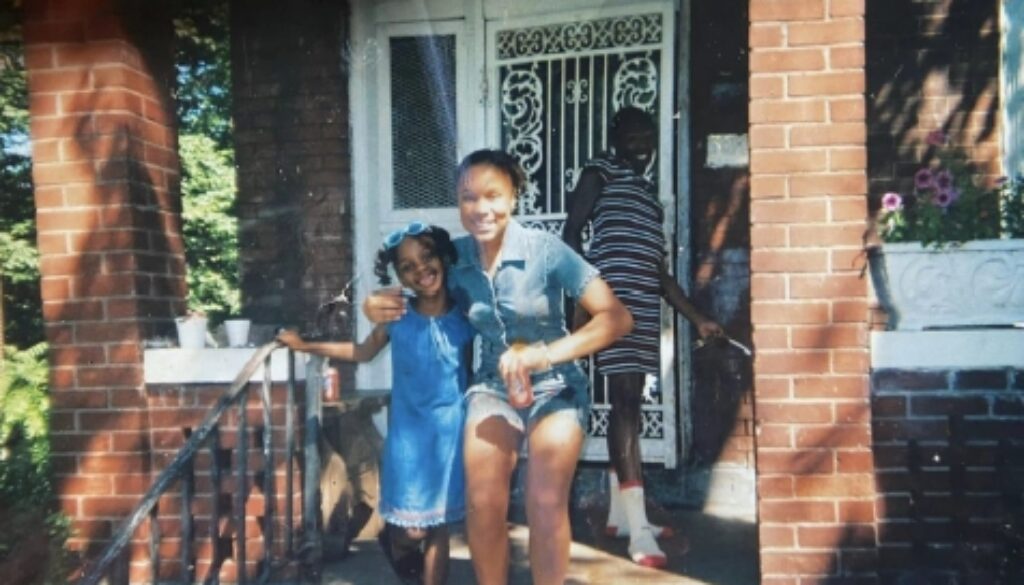
The home I lived in as a kid is the same home where my grandparents raised 15 children, and where my mom raised five more. My grandparents bought it after moving up from Arkansas. Sharecropping wasn’t earning them the money they needed, so they joined the Great Migration, the period spanning nearly half a century when six million Blacks moved from rural southern states to urban northern cities. My grandparents packed up the few children they had by then, and landed in the two-story red brick home on Vine Grove Avenue in the Greater Ville neighborhood of north St. Louis.
Once settled, my granddaddy became the founder and pastor of St. Samuel Temple Church of God in Christ. They went on to add to their family, with my grandmother delivering some of her children on Vine Grove with the aid of a midwife.
I used to imagine her walking through that door just like I did with my first-born, Ahkeem.

I remember feeling “I’m gonna be okay” once we walked into the freshly painted upstairs nursery. My son would be the fourth generation of my family to start a life in this home. He enjoyed his childhood, and I enjoyed my childhood as well, though you might wonder if you looked at crime statistics or newspaper accounts of murders and gangs in the neighborhood. Being home was our safe space from the crazy world. Today there are more vacant lots than houses on the block. Our house might not look like much to others, but inside it was filled with character and life and unconditional love. I had so many friends, and we would be in each other’s homes till dark until their mommas and daddies made us go home.
As the years passed though, many of my friends left the neighborhood, and I started finding trouble. A fight landed me in what I called Judge Jimmie Edwards’s “school for bad kids.”
People magazine wrote a story about Judge Edwards and his work with at-risk youth. Then the writer and others began making a documentary about the school, officially called Innovative Concept Academy. They started to follow me around school and at home, and later titled the documentary “For Ahkeem,” as a dedication to my son born during filming, and to my struggle to build a better life for him. I remember a moment they filmed for the documentary, when I was holding Ahkeem in the nursery and watching the unrest in Ferguson on TV after the killing of Michael Brown. I worried about what my Black son might face when he grew up. But like me, my momma was determined to keep him safe within our walls. The house on Vine Grove was our backbone and if you ever needed a place to go, it would always be there. Momma knew that and over the years spent what little she had to keep it well maintained, even after she moved to another home nearby. A few months ago, she put $5,000 toward tuckpointing to help my brothers who were living there. My upstairs room was still set up the exact same as when I left it, in case I ever needed to go home.
***
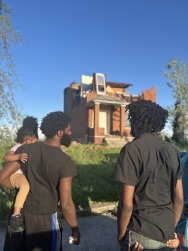
As I was talking to my mom on the phone the afternoon of May 16, I noticed the sky beginning to turn green outside my rental house in Glasgow Village, a suburb of north St. Louis County. Then it got dark as night. At the same time, our cell call dropped. I tried to reconnect. No luck. I turned on the news. There’d been a tornado, later determined to be a category EF3. It ripped through wealthy neighborhoods in Clayton, then Forest Park and the Central West End, before turning toward the struggling north St. Louis neighborhoods where I’d grown up and spent 20 years of my life, leaving only piles of rubble and bricks.
My aunt called and shared pictures of what happened to the Vine Grove home across the street from hers. The tornado had cut off the top half of the house. It left me heartbroken, though not as much as my mom. She could not even go to look. All of her memories of her childhood, our childhood and her grandkids’ childhoods destroyed in 30 seconds.
That day my brother Dejon had planned on cutting the grass and staying home. I’m so glad he didn’t and that my other brother, Sylvester, was elsewhere too. I went to see the house and encountered childhood friends and neighbors that I hadn’t seen in at least 10 years. An old friend grabbed me and gave me a hug and I sobbed like a baby. But I found a measure of joy, too. The community shows up. There is a sense of unity that I felt all the time as I was growing up.
Let me tell you how that was even possible…
Joy and fear, pleasure and mayhem rode side-by-side in my little neighborhood. You never knew when you might encounter one or the other.
***
I was around five years old when I saw my first body. My daughter, Aria, is that age now and I could not imagine how that would change her.
A neighbor was trying to help us out by working on our washer and dryer and somehow he electrocuted himself. I remember my brother, sister and I just stood there as he lay dying.
His stomach may have always been big, but it blew up. Lying in a puddle of water, he smelled like chicken with no seasoning. The lights flickered on and off. Then my mother came running down the stairs to get us.
She had called the police and his family. A white van pulled up and took him away in what we thought was a trash bag. His family wept outside our home until he got carried away.
These days social workers might have been involved to provide mental health services, so-called trauma-informed care. All I can tell you is that I got none of that, I just know it made me see life differently though I don’t have all the words to explain it.
For a good part of my childhood, I experienced life without simple necessities, including regular water, heat and lights. My first five or six years, we lived in a house in the Penrose neighborhood, on Anderson Street, just a 15-minute walk from my granny on Vine Grove. My mother raised us alone after she and my father split up. We lived in a three-bedroom house with older cousins. On school days I might wake up to find as many as 10 grown men stretched across the living room floor.
A man named “G-Nut” used to do my hair before school. He was what we called a gang banger, a member of a violent criminal gang. G-Nut got sent to prison for killing someone a few months after he moved into our house. And yet, he was just fine around us. We never saw his conviction coming.
Soon enough though, we grew used to killings all around us. At bedtime, my siblings and I would count the gun shots we heard as we drifted off to sleep. Fear drove many people away. Our family adapted to it, living in the house we owned. My stepfather had a gun and he taught me to shoot it. I feared the sound but remember enjoying the experience.
I know that sounds wild, maybe even more so when I tell you that when I was nine years old my cousin Terron died while playing Russian roulette. His blood spattered over his brother Ronnie’s wheelchair. Ronnie was in that chair because he had been shot just a month before in another incident.
So, to say the least, I was an at-risk child. Everyone around me knew that about me and could see that risk growing at an alarming rate.
I was so bad the summer before I started high school that I was sent to Chicago to live with my aunt Mary Sue and her husband. That experience did calm me down a bit and I returned to start my freshman year at Sumner, known as the first Black high school west of the Mississippi.
I remember one day in the cafeteria, a boy asked if I would be his girlfriend. I agreed and we became close. Just a few months later, I got a call from his mother wondering where he was. Hours later, I got a text from her. He had been found dead. You may remember the Crips and the Bloods. He was a Blood and his friends, including me, wore their color red to his funeral. He was 16 when he was killed. His mother never knew why.
Honestly, at that point in my life, I didn’t expect to live much longer myself. And I came very close to living up to my own prophesy. Not long after my friend lost his life, I was grazed in my stomach during a shootout on Vine Grove. I remember running and blacking out after the bullet had hit my stomach. I thought I was dying at that moment. Now, being around fireworks or hearing gunshots, I’m like an army vet. I run, duck, or get on the ground.
***
I am now the mother of four. I shield my babies from that lifestyle. I live in a much better neighborhood and now have a man in my life who is responsible and caring. But two of my babies’ fathers are in prison for killing someone. I tried to pick good people but I just didn’t. I met them at times in their life when they needed healing, and they looked to me to find it. I never thought I’d be the mom explaining to my children that their dads are in jail for taking a life. How does that conversation even start?
How do I make ends meet? I work as a home health care aide. But I know I must do better. So, I have taken communications courses at St. Louis Community College – Forest Park. I want to become a professional journalist, and this is a start, the first in a series that I plan to share as my family deals with the aftermath of the tornado. Through my narrative, I’ll share more about me, but also what it takes for families on the margins to survive and try to thrive in troubled times.
I had long said I wanted to leave St. Louis. But then I saw how much everyone across this region came together and it brought me such joy. Neighbors helping neighbors in whatever way they could. Until the tornado, you would hardly ever see white people on our side of town, but there they were handing out food, water and even helping to board up homes. So many homes remain covered with tarps, but my neighbors would rather live in tents beside their homes than leave their community.
Birthed in a storm, raised in chaos and living at times in hell will not determine who I become. I love my city too much. I owe it to the young people here to stick around. I want to be their voice.